Short answer: a useful 30-day pilot for a voice reporting tool covers one crew or one line, agrees on one metric and its baseline on day 0, reviews the records weekly, and ends with a readout and a clear decision. Most pilots fail because nobody wrote down what success looks like before they started.
Why maintenance and EHS pilots stall
Plants try new tools all the time. Many of those trials end the same way: a few people use it for a week, the champion gets pulled onto a shutdown, and after a month nobody can say whether it worked. The tool is not always the problem. The pilot had no baseline, no owner and no end date.
A voice reporting tool is easier to pilot than most, because it does not replace anything. The crew keeps its CMMS and its EHS software. The only change is how observations get captured. That makes it a good candidate for a short, structured test.
A 30-day pilot plan
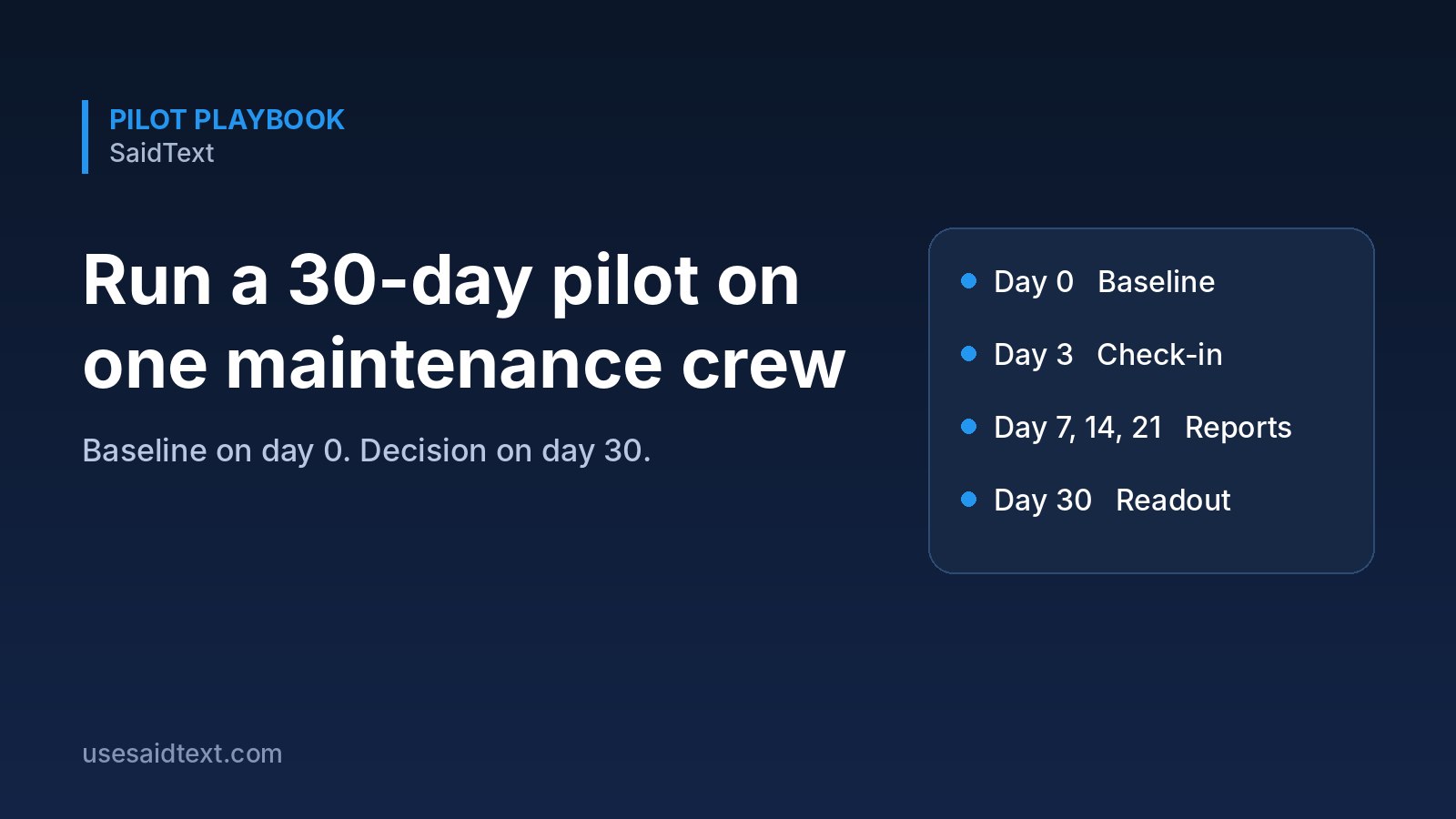
Day 0: scope and baseline. Pick one crew or one line. Pick one metric that matters to you, for example how many shift handovers have a written record, how many near misses are reported per week, or how long it takes to write up a repair. Write down today's number, even if it is an estimate.
Day 3: check-in. Are people using it? What is getting in the way? Fix the small things early: where the phone lives, who reviews the records, which words the crew uses for each asset.
Days 7, 14 and 21: short written reports. How many records were created, by how many people, and what kind. Read a sample of the records. Are they something the next shift or the planner would actually use?
Day 30: readout and decision. Compare the metric with the day 0 baseline. Decide: stop, extend to a second crew, or roll out. Write the decision down, with the reason.
What to ask the vendor before you start
- What does the crew need on day one: phones, a shared tablet, anything else?
- Does it need an IT project or an integration to start? (It should not, for a pilot.)
- Who reviews a record before it is filed?
- Can we export the records, and in what format?
- What happens to our data and audio at the end of the pilot?
- What does it cost if we continue?
How SaidText runs its pilot
SaidText is a voice capture layer for maintenance and safety crews. Techs say what they see, a supervisor reviews, and it becomes a structured record your team can search and export. It sits before your CMMS and EHS tools and does not replace them.
The pilot is free for 30 days on one crew or one line, with no contract. It follows the plan above: a baseline on day 0, a check-in on day 3, short reports on days 7, 14 and 21, and a readout on day 30. In return we ask for usage data, honest feedback and, if it works, an optional reference. If you continue, our public pricing applies.
Frequently asked questions
How long should a software pilot in a plant last?
Thirty days is usually enough to see whether a crew adopts a capture tool, as long as the metric and baseline are agreed on day 0.
How many people should be in the pilot?
One crew or one line. Small enough to support closely, big enough to see real use across shifts.
What is a good metric for a voice reporting pilot?
One that is easy to count and matters to you: written handovers per week, near-miss reports per week, or time to document a repair.
How do we start?
Request a free 30-day pilot and tell us your site, your role and the CMMS you run.