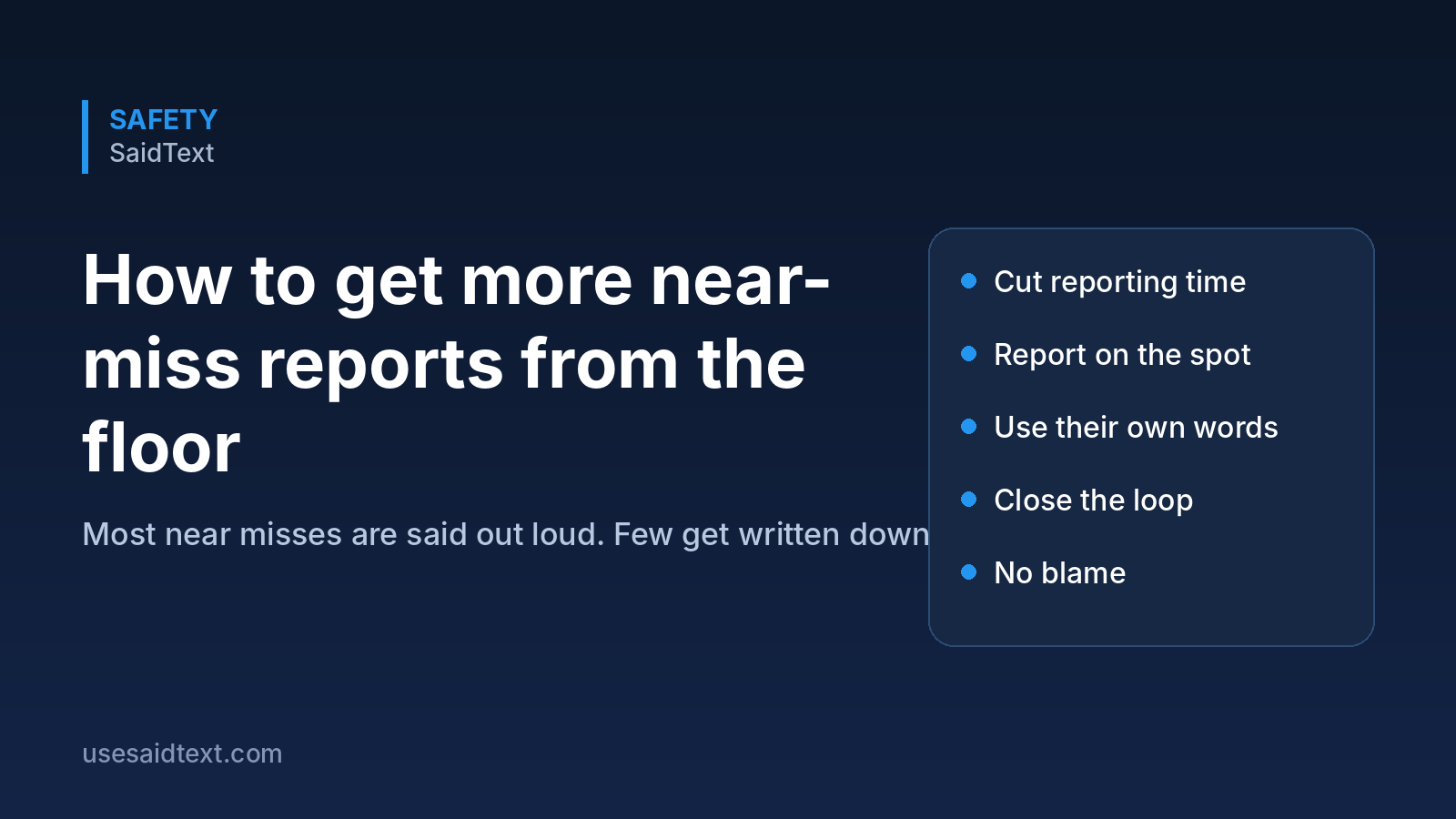
Short answer: to get more near-miss reports, make reporting cost the worker almost nothing, show that reports lead to action, and never punish the person who reported. Most near misses are not hidden. They are said out loud on the floor and never written down, because the form takes longer than the conversation.
Near misses are already being reported, just not recorded
Ask any supervisor whether people tell them about near misses. Most will say yes. Someone mentions a loose rail, a forklift that came too close, a guard that does not sit right. The information exists. It just never reaches the system, because reporting means stopping work, finding a terminal or a form, and filling in twenty fields with gloves on.
So the near miss lives for one shift in someone's memory and then disappears. Until the same hazard becomes an incident.
Five ways to get more near-miss reports
1. Cut the time it takes to report one. If a report takes ten minutes, you will get the reports people feel obliged to write, not the ones that matter. Aim for under a minute. The fewer required fields, the better; the rest can be filled in later by the EHS team.
2. Let people report where they are. Reports made at the location, right after the event, are more accurate than reports written at the end of the shift from memory. A phone in a pocket beats a terminal in the office.
3. Let people report in their own words. Many floor workers are comfortable talking and less comfortable writing, and some prefer another language. Accept a spoken description and structure it afterward.
4. Close the loop visibly. When a report leads to a fix, say so at the next toolbox talk. People report more when they see that reports change something.
5. Separate reporting from blame. A near-miss program fails the first time someone is disciplined for what they reported. Make it clear that reports are about hazards, not people.
Where voice capture fits
Voice capture addresses the first three points directly. The worker says what happened, where and when, in a few seconds. A tool like SaidText turns that into a structured safety record with a timestamp, routed right away to the right person, and a supervisor or EHS manager reviews it on the dashboard. The worker chooses what to dictate; nothing is recorded in the background.
It does not replace your EHS software or your incident process. It is the input step before them, the part that usually breaks. Records can be searched and exported, so they support your existing reporting and OSHA documentation workflows. It is documentation support, not a compliance guarantee.
What to measure
For one area or one shift, track for a month:
- near-miss reports per week;
- time from the event to the report;
- share of reports that lead to a corrective action.
More reports is not a bad sign. In most plants it means you are finally seeing what was already happening.
Frequently asked questions
Why are near misses under-reported?
Mostly because reporting takes time and attention workers do not have during a shift, and sometimes because people fear blame. The hazard is usually mentioned out loud, just not recorded.
What is the fastest way to report a near miss?
Saying it at the location, right after it happens, and having it turned into a record automatically. Typing it later is slower and less accurate.
Does voice reporting work in noisy plants?
That depends on the floor. The best way to know is to test it on your own floor for a few weeks before deciding.
How can we test this?
SaidText offers a free 30-day pilot on one crew or one line, with no contract. You can request a pilot here.